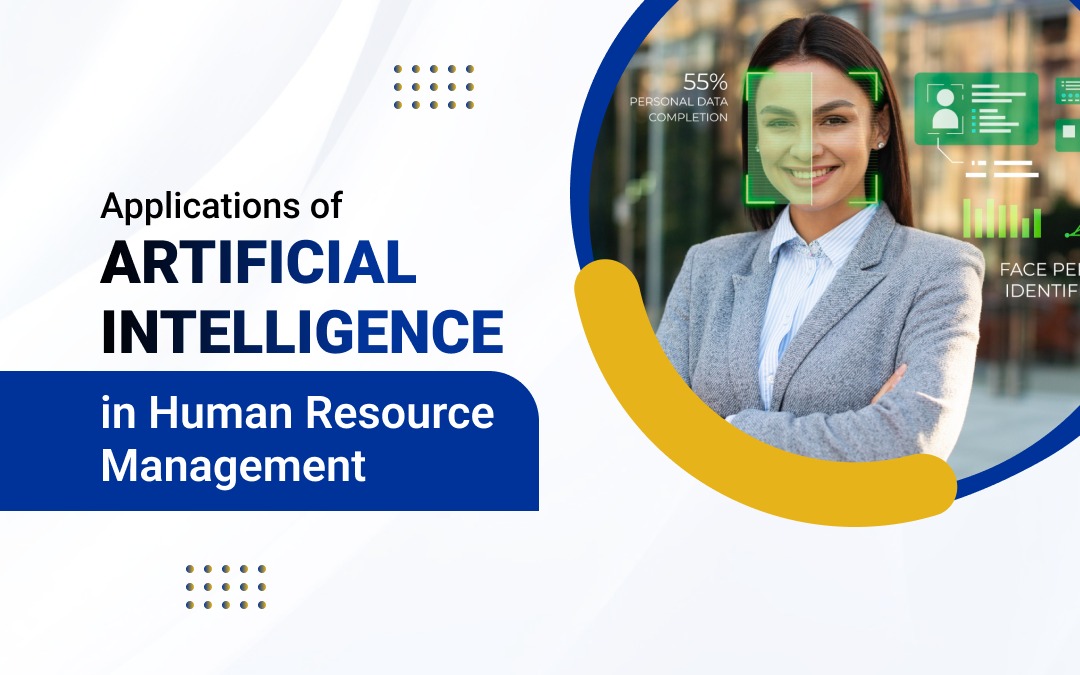
Artificial Intelligence (AI) is rapidly transforming the way organisations manage their human resources. Traditionally, Human Resource Management (HRM) focused on attracting, selecting, training, motivating, and retaining employees.
Today, AI is adding a new dimension to these functions by making HR processes more intelligent, data-driven, adaptive, and efficient.
One of the primary goals of HRM is to design and implement organisational processes and practices that convert human resources into valuable, rare, and difficult-to-imitate strategic assets, thereby helping organisations achieve sustainable competitive advantage.
In this context, AI is emerging as a powerful enabler of strategic HRM.
AI in Recruitment and Selection
Recruitment is one of the most visible areas where AI is making a significant impact. AI can be used at multiple stages of the hiring process, from screening applications to assessing candidates’ suitability for a role.
AI-enabled algorithms can analyse the characteristics of high-performing employees and identify the competencies associated with success in a particular job.
These competency profiles are then used to shortlist potential candidates from a large pool of applicants.
AI systems are also increasingly being used to conduct virtual interviews and assess candidates using video analytics, communication patterns, and behavioural indicators.
Such systems improve the efficiency and speed of hiring while reducing administrative costs. Structured AI-assisted interviews may also help organisations minimise certain forms of human bias in recruitment decisions.
Companies such as
HireVue
and
Vervoe
are among the pioneers in AI-enabled video interviewing and structured interview analytics.
The contours of AI applications in recruitment continue to expand to include behavioural analytics, gamified assessments, and competency-based simulations.
AI in Employee Retention
Employee retention is another important area where AI can play a strategic role. The loss of high-performing employees often leads to productivity disruptions, increased recruitment costs, and loss of organisational knowledge.
AI systems can help organisations predict employee attrition by analysing patterns related to engagement, performance, absenteeism, compensation, promotion history, and workplace interactions.
Advanced predictive analytics systems can assign a “flight risk” score to employees, indicating the probability of their leaving the organisation.
Such insights enable managers to proactively intervene through career development opportunities, mentoring, training, or role redesign initiatives.
AI in Employee Training and Development
AI is also transforming employee learning and development from a one-size-fits-all approach into a highly personalised, adaptive, and data-driven process.
AI systems can recommend customised learning paths based on employees’ roles, skill gaps, learning behaviour, and career aspirations.
For instance, a sales employee who requires improvement in negotiation skills may be assigned simulation-based exercises tailored to specific customer scenarios.
Similarly, AI can recommend advanced learning modules based on job requirements and employee performance patterns.
AI applications are increasingly being used in communication and soft-skills training as well.
Intelligent learning systems can assess vocabulary usage, confidence levels, tone, clarity, and speaking pace, while offering real-time feedback to learners.
AI-driven learning platforms are highly adaptive and can dynamically adjust the pace, complexity, and format of content according to learner characteristics and progress.
Another emerging area is the use of generative AI to develop training materials, quizzes, role-plays, caselets, and micro-learning modules, thereby significantly reducing content development time.
CAJON Framework: A Case in Point
One of the emerging developments in AI-enabled HRM is the CAJON Framework (Capability-Aware Job Optimisation Network), an AI-driven system that generates dynamic, intelligent job descriptions (JDs).
Unlike traditional job descriptions, which are often static and periodically updated, the CAJON framework develops capability-oriented JDs aligned with organisational goals and contextual requirements.
Assume that an HR manager or line manager provides the following structured prompts to the AI system:
- Function: Supply Chain
- Level: Mid-Senior / Band 4
- Outcome: Reduce stockout rates in the North region by 20% within six months
- Context: Must coordinate across procurement, warehouse, and sales analytics teams
These prompts provide the AI system with contextual information regarding the purpose and expectations of the role.
Using the CAJON framework, the AI extracts relevant capabilities and classifies them into technical, behavioural, and compliance-related categories.
The system can then integrate information from internal databases relating to job families, job levels, pay bands, competency frameworks, and behavioural indicators.
Based on this capability profile and internal alignment, the AI system generates a comprehensive JD that may include:
- Role purpose
- Key responsibilities
- Required capabilities
- Behavioural competencies
- Key Performance Indicators (KPIs)
- Qualifications and experience requirements
The framework can also be designed to check for potential legal and ethical violations, thereby improving standardisation and compliance.
Dynamic AI-generated JDs offer several advantages over traditional job descriptions, including greater speed, consistency, flexibility, and strategic alignment with evolving business needs.
Challenges and Limitations
Despite its enormous potential, AI in HRM is not without limitations.
Concerns relating to employee privacy, data security, transparency, and algorithmic bias continue to pose significant challenges.
AI systems are only as reliable as the data on which they are trained. Biased or incomplete data may result in unfair or discriminatory outcomes.
Moreover, HR decisions often involve empathy, contextual understanding, ethical judgment, and interpersonal sensitivity — areas where human judgment remains indispensable.
Therefore, AI should be viewed primarily as a tool for augmenting managerial decision-making rather than as a replacement for human responsibility and accountability.
The future of HRM is likely to involve collaborative intelligence, in which human expertise and AI capabilities complement each other to build more effective, agile organisations.
— Dr. Senthil Kumar S.
Professor, OB & HRM
Institute of Management Technology Nagpur